Report
8 min read
• May 5, 2026Integrating sustainability into what we do
Protect Tomorrow. Today. is the guiding principle behind our approach to sustainability in our operations. It gives us a consistent focus on doing the right thing, the right way.
Report
8 min read
• May 5, 2026Navigate to:
How we achieve our strategic priorities is as important as the results. Our directors, officers, and employees are expected to observe the highest standards of integrity.

Leadership: Our governance and business ethics underpin our actions and behaviors. This internal leadership drives our policies, systems, expectations and standards.
Application: Strategies, capital, innovation and stakeholder engagement enable us to focus our resources and develop plans in the areas of greatest potential importance to society and ExxonMobil.
Performance: Execution of plans, processes and stewardship of progress support delivery in areas of focus and drive continuous improvement.
Application: Strategies, capital, innovation and stakeholder engagement enable us to focus our resources and develop plans in the areas of greatest potential importance to society and ExxonMobil.
Performance: Execution of plans, processes and stewardship of progress support delivery in areas of focus and drive continuous improvement.
We are ExxonMobil leadership culture
The strength of our culture is foundational to our success. The We are ExxonMobil culture framework encompasses our core values and leadership expectations. This framework also outlines key behavioral skills that apply to all employees.
Our culture is built on a strong focus on leadership and key talent systems, including performance assessments, on-the-job experience, and formal training. Through our collaboration with the University of North Carolina, our leadership programs are designed to help our leaders connect We are ExxonMobil with our strategic priorities and unlock the collective potential of our employees. More than 1,700 leaders attended these training programs offered at locations around the world in 2025.
ExxonMobil’s core values

Integrity is first among our core values for a reason. It underpins our dedication to uphold high ethical standards and to do what’s right in all aspects of our business.
We encourage employees and contractors to ask questions and voice concerns, and we insist that alleged violations of company policies be reported. Our open-door communication procedures provide formal and informal mechanisms for employee feedback, including both a mailing address and 24-hour hotline for anonymous reports, among other options. Maintaining confidentiality to the extent possible is critical, and we have protections in place to prevent retaliation. In addition, our annual year-end supplier expectations letter provides mechanisms, including phone numbers by region, for feedback from suppliers.
A quarterly summary of reports of suspected violations of the Company’s policies is provided to the Board’s Audit Committee. This committee consists of five independent (i.e., non-employee) directors who help the Board in overseeing financial reporting, accounting, and internal controls. This includes legal and regulatory compliance, as well as compliance with company policy. Confirmed violations can lead to disciplinary actions, up to and including termination.
Regular internal audits and self-assessments help us verify the strength of our control systems and adherence to our Standards of Business Conduct. Our team of internal auditors has access to all operations, records, personnel, and properties. They review our activities and processes on an ongoing basis, and suspected noncompliance is investigated.
Our Standards of Business Conduct
Our Standards of Business Conduct include what we call “foundation policies” defining the basis of our conduct worldwide. The Board of Directors has adopted and oversees the administration of the Standards, and no one at ExxonMobil can make exceptions or grant waivers to these policies.
Our foundation policies cover aspects of the environment, health, safety, product safety, customer relations, equal employment opportunity, harassment in the workplace, and more. They also define ethical conduct for our company, which includes our values on important matters like human rights, labor, the environment, and anti-corruption.
Our Standards of Business Conduct are a key part of onboarding new employees, and they are reinforced with employees annually. Wholly owned and majority-owned subsidiaries of Exxon Mobil Corporation generally adopt policies similar to our corporate Standards.
Our directors, officers, and employees are required to review these policies annually and apply them in their work. Employees are regularly required to complete business practices training. And, of course, we require all employees, officers, directors, and those working on our behalf to comply with all applicable laws.
Employees in relevant job functions receive training on antitrust, anti-corruption, and trade laws (including anti-boycott, trade sanctions, and export controls topics) on an annual or biennial basis. ExxonMobil-specific and other relevant training is shared with contractors if required to perform contracted services. In 2025, more than 18,000 employees and contractors participated in relevant training.
Corporate governance
Our Board of Directors oversees our strategy, providing strong corporate governance and guidance to management.
Our Sustainability organization
Our Sustainability organization touches every part of ExxonMobil, making use of our scale, capabilities, and the synergies between our business lines. A member of the Exxon Mobil Corporation Management Committee provides functional guidance to the Sustainability Vice President. This role is responsible for driving our Protect Tomorrow. Today. guiding principle in our operations.
This includes:
- Working with our Corporate Strategic Planning organization and the business lines to identify opportunities.
- Integrating opportunities into our plans and operations.
- Stewarding sustainability topics with our Chairman and the Management Committee at least once per quarter.
The Sustainability organization manages the environmental management system and sustainability focus areas. This centralized organization drives our sustainability efforts and initiatives, guides our value chains, and supports execution excellence across our sustainability focus areas. Experts within the team work with others across the company to seek out opportunities for continuous improvement.
Our sustainability focus areas
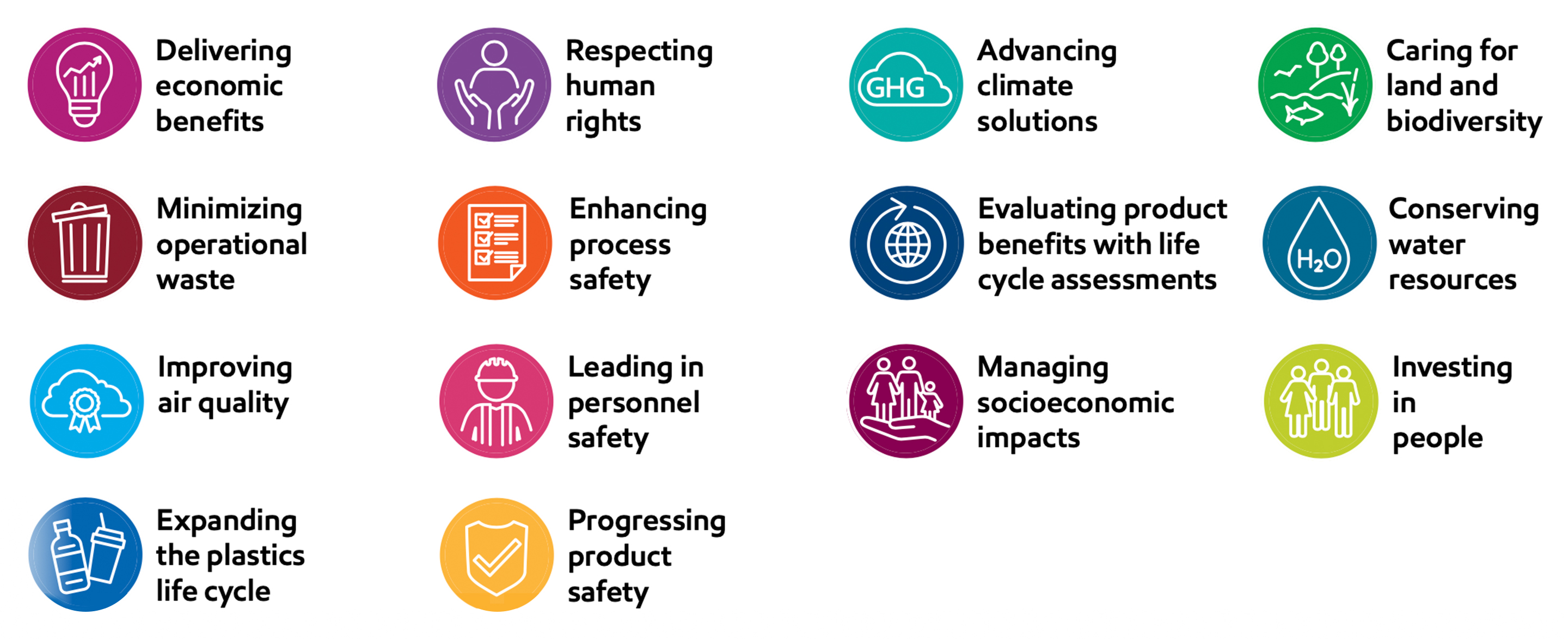
Our 14 Sustainability Focus Areas were developed by analyzing our environmental and social impacts, business strategies, current events, and internal and external stakeholders’ priorities. We believe these focus areas are the most relevant to our company and important to society. We develop strategies, allocate resources, and execute plans to address risks and opportunities within each of them.
Topic selection process
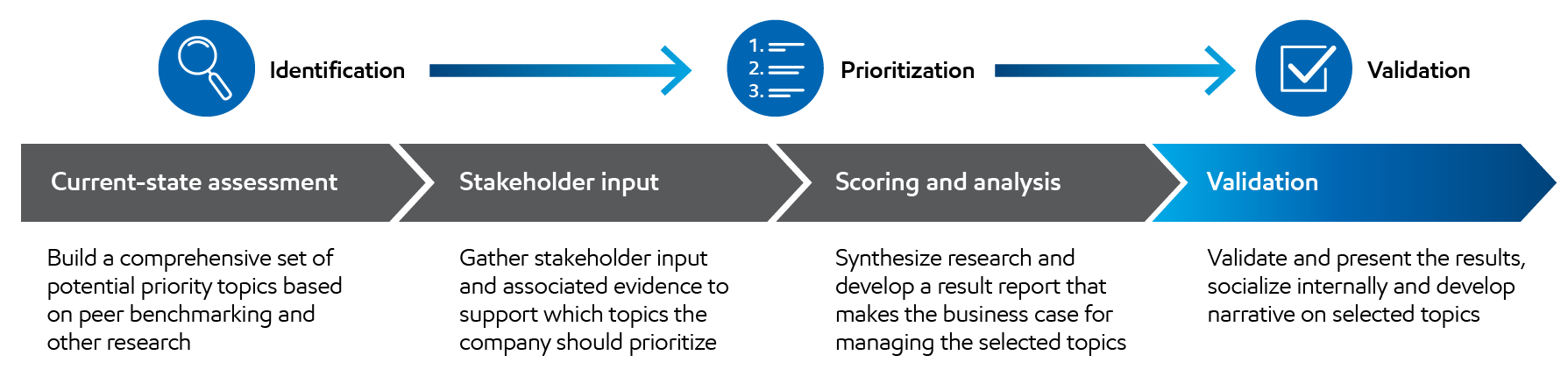
We conduct regular assessments to identify sustainability-related topics of interest to stakeholders and to enhance our understanding of current events and evolving business priorities. The findings help inform the development of our Sustainability Report.
In 2024, we engaged a third party to refresh our topic selection in line with the Sustainability Reporting Guidance for the Oil and Gas Industry (4th edition, 2020, revised February 2023) developed by Ipieca, the American Petroleum Institute, and the International Association of Oil & Gas Producers, reaffirming the importance of the topics discussed in this report.
In 2025, Ipieca published a new edition.1 It describes important topics as those that, in the view of a company’s management and external parties, have the potential to significantly affect a company’s sustainability performance and stakeholder awareness, assessments, or decisions.2
To select our topics, we also analyze peer and industry reporting, regulations, and media to gain data-driven insights into strategic, regulatory, and reputational risks and opportunities.
Inputs include:
- Peer benchmarking.
- Review of leading sustainability frameworks.
- Regulatory guidance.
- Third-party research.
- Internal and external stakeholder engagement.
Our Sustainability leadership reviews and validates the results of this topic selection process.
Communicating our performance
Performance data
Our metrics are informed by the Ipieca, the American Petroleum Institute (API), and the International Association of Oil & Gas Producers (IOGP) Sustainability Reporting Guidance for the Oil and Gas Industry (5th edition, 2025).
Our Content Index lists indicators from this guidance covered in our Sustainability Report.
Our Publications
In addition to our Sustainability Report, we publish comprehensive reports to provide insight into how we create value through our integrated businesses and how we manage associated risks, opportunities, and impacts.
Our reports
- Global Outlook
- Investing in People
- Advancing Climate Solutions
- Worldwide Giving Report
- Annual Report
- Advocacy Report
Our systems, expectations, and standards
We have built an organizational and governance structure around our focus areas to ensure top-to-bottom and bottom-to-top alignment. Our objectives and strategies ensure a consistent approach across the company, while empowering our business lines to take action and advance our sustainability priorities.
Our Environment Policy is part of our Standards of Business Conduct. It details our commitment to continuous efforts to improve environmental performance throughout our operations.
Across our global operations, we apply rigorous management systems to identify, track, and report performance metrics. These systems help us comply with applicable laws and regulations and provide a framework for maintaining high standards, even where laws or regulations don’t exist.
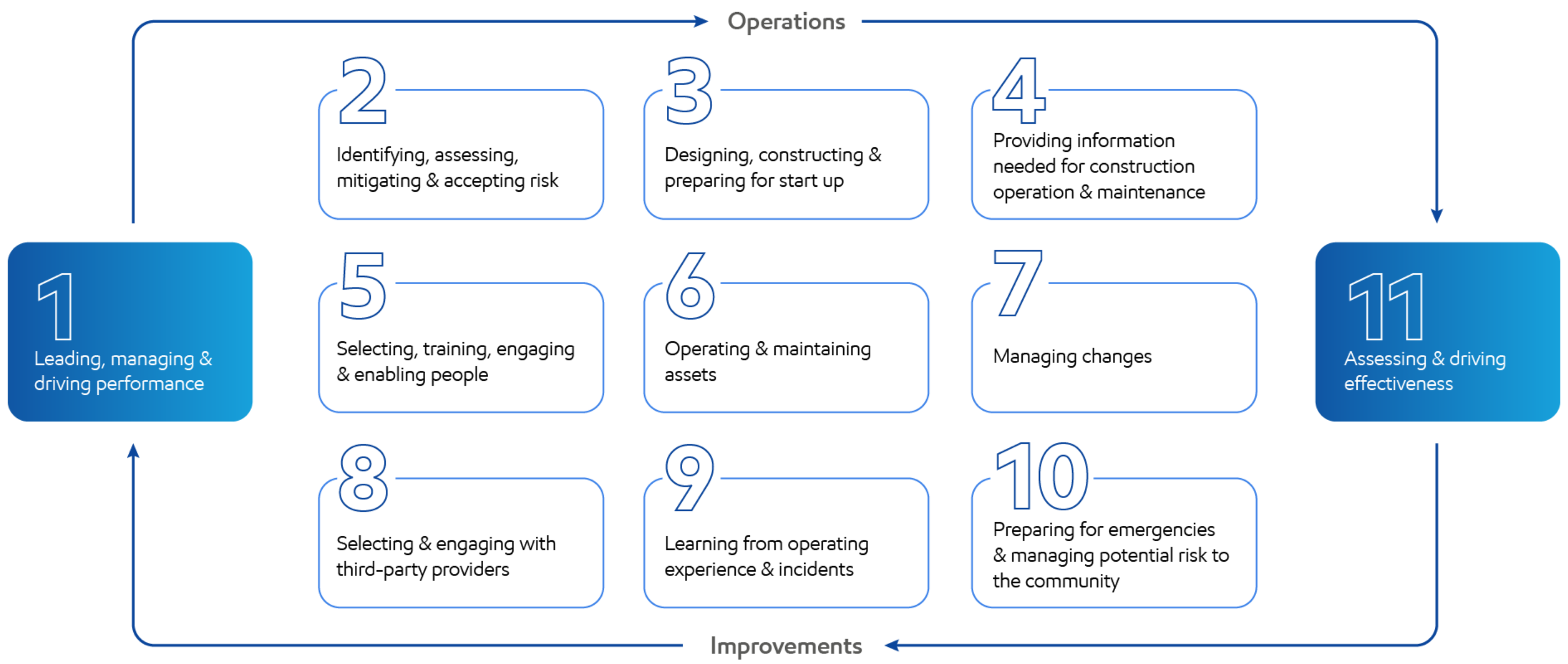
Our Operations Integrity Management System (OIMS) establishes expectations, protocols, and guidance that apply across all our operations to address risks inherent to our business, including environmental risks.
Each element of OIMS contains overarching objectives, specific expectations, and detailed processes for implementation. The OIMS framework is applied across ExxonMobil, and we monitor the performance of our operated and non-operated assets (e.g., joint ventures) against OIMS expectations.
Using OIMS to manage environmental performance and compliance
We use OIMS to bring our Environment Policy to life, from identifying risks to assessing effectiveness.
OIMS meets International Organization for Standardization (ISO) 14001 standards for environmental management systems (certified by Lloyd’s Register Quality Assurance) and the requirements of American Chemistry Council Responsible Care®. Across our global lubricants operations network, 19 of the 20 plants are ISO 14001- certified, with the newest facility in India scheduled to be assessed.
Excellence in project execution is built on deep insight into the unique traits of the areas where we operate. It requires clear standards and an understanding of the potential impacts of the work we do.
Key efforts that work with OIMS
Across our business, we use established tools and processes to help our people to identify, evaluate, and act on the wide range of environmental and socioeconomic aspects and risks in our operations.
Environmental Aspects Guide (EAG)
The EAG is the foundation of our understanding of the environmental and socioeconomic implications of our business. Built on ISO-14001, the EAG helps us define the relevant environmental and socioeconomic aspects of our operations. Aspects are those activities, products or services that can interact with the environment, including those that primarily interact with the socioeconomic environment.
-
Environmental Aspects Assessment (EAA)
Informed by the EAG, these assessments are a key step in evaluating the socioeconomic and environmental aspects we identify. Depending on the activity, this may include water use, air emissions, biodiversity, sound, land use, and others as appropriate.
Through the EAA process, we identify and prioritize environmental aspects; assess potential environmental impacts and risks; and understand the setting in which our activities interact with the natural, regulatory, and socioeconomic environment. -
Risk Assessment
A deep understanding of the aspects in the EAAs enables us to identify and analyze key environmental, socioeconomic, and health risks, and to develop risk management strategies throughout an asset’s life cycle. A variety of tools, catered to the work we’re undertaking, may be deployed based on identified aspects, permitting needs, or other variables. For major new projects, we typically perform an Environmental Socioeconomic Health, and Impact Assessment (ESHIA).
Environmental Planning
Environmental Planning is an annual process that reviews key environmental priorities, develops strategies to meet environmental objectives, and integrates those strategies into company plans. It helps balance economic growth, societal development, and environmental performance.
As we plan major capital projects, our Project Environmental Standards (PES) set the minimum environmental and socioeconomic requirements we follow, even where regulations fall short. Originating from standards created for our upstream projects, PES were formalized for all business lines in 2010 and harmonized company‑wide in 2021. We continue to update them as needed.
We offer training on these processes and other environmental and socioeconomic topics to employees as part of our ongoing development efforts. Employees have completed more than 14,000 of these courses since 2022.
Other procedures, practices, and systems
Across the company, we have a number of other systems and procedures to help us identify and manage risk – often tailored to specific parts of our business. Some key examples include:
- ExxonMobil Capital Projects Management System (EMCAPS): EMCAPS provides a framework for project development and execution and helps account for environmental and socioeconomic concerns, as well as regulatory requirements.
- Environmental Data Management System (EDMS): The EDMS is used to collect, collate, and consolidate site-level data at the corporate level to help manage environmental performance indicators globally.
- Personnel Safety Management System (PSMS): PSMS is a tool designed to consistently deliver “safety in the moment” by enabling effective management of safeguards before and during higher-risk work.
- Product Stewardship Information Management System (PSIMS): This system applies common global processes and a global computer system to capture and communicate information on the safe handling, transport, use, and disposal of our products.
- Controls Integrity Management System (CIMS): The CIMS is used to assess and measure financial control risks, identify mitigation procedures, monitor compliance with standards, and report results– an important validation of OIMS’ work.
- Global Energy Management System: This system identifies opportunities to improve energy efficiency and reduce greenhouse gas emissions intensity in downstream and chemical operations.
- IMPACT: This corporate-wide database captures and analyzes safety and environmental data on incidents, near-misses, observations, assessment findings, lessons learned, and follow-up activities.
- Business Continuity Plans (BCPs): We manage business continuity as a key component of OIMS and our controls to prepare us if an incident were to occur. Our BCPs include a suite of enablers that we can activate as needed.
- National Content Guidelines, Strategies, and Best Practices: This document outlines the key elements of our national content strategy and plan, models, and tools for the successful development of national content, as well as roles and responsibilities at the corporate, country, and project levels.
- Technology Management System: This system includes processes for technology investments that follow a gated management system from early technical innovation to final deployment.
- Cyber Business Continuity Plans: As part of our cybersecurity program, cyber BCPs provide a basis for cyber resiliency and incident response across the company. Our Form 10-K filing provides details about the management and scope of our cybersecurity program.
- Data protection and privacy: We maintain comprehensive programs to protect personal data. We handle personal information in line with applicable laws, guided by a data privacy code of conduct and common principles (e.g., purpose limitation, transparency, data security, accuracy, and data minimization).
More information
Responsible AI Principles
We have a history of leveraging technology to drive business value. We consider potential security and safety risks of new and developing technologies.
The power of artificial intelligence (AI) technology, for example, can expand the capabilities of our workforce. AI has the potential to empower our employees to leverage their skills and, in doing so, boost operational efficiency and enhance our business capabilities.
To bring AI-enabled solutions to our business at scale we:
- Test reliability, security, and performance.
- Develop tools and best practices.
- Gain exposure to emerging technologies and suppliers.
- Develop guardrails and our AI strategy for adoption at scale.
Our strategy brings our efforts together in a single ecosystem to help scale AI technology across the organization. Our strategy is built on six elements:
- Business-led: Reimagine our business functions and deliver outstanding customer experiences at lower costs.
- Talent: Equip people with AI skills and capabilities to envision and execute innovation.
- Operating model: Develop synergies as we find uses for AI across the company at pace and scale, while reducing costs.
- Technology: Provide the right tools and technology to address business needs and opportunities.
- Data: Continuously improve the quality and availability of our data to provide relevant insights and enhance decision making.
- Responsible AI: Based on industry standards like the NIST AI Risk Management Framework, our Responsible AI Principles guide our efforts in aspects related to safety, security, fairness, and privacy.
Supporting the United Nations Sustainable Development Goals
The United Nations has adopted the Sustainable Development Goals (SDGs) to achieve progress on global economic, social, and environmental challenges. The goals are directed at governments, but the private sector and civil society play an important role in supporting national plans. We support governments’ efforts to meet the SDGs.
For example, our corporate strategy directly supports progress toward SDG 7, “Affordable and Clean Energy.” To meet the U.N.’s goal to “end poverty in all its forms everywhere,” providing for basic energy needs is a must. As described in our Global Outlook, about 4 billion people – half the world’s population – lack access to the energy needed for housing, infrastructure, jobs, and other basic human needs. Our analysis estimates that the most basic living standards require a person to use at least 50 million British thermal units (MMBtu) per year. To put that in perspective, people in developed countries around the world use more than three times that amount – about 160 MMBtu per person. With 50 MMBtu per capita, a country can:
- Provide universal access to electricity.
- Eliminate abject poverty.
- Provide universal access to clean cooking fuels.
As we continue to help supply the energy products the world needs, we also support progress toward SDG 13, “Climate Action.” Reducing greenhouse gas emissions is the other half of our “and” equation. We’re pursuing approximately $20 billion of lower-emission investments between 2025 and 2030.3 Pacing of these opportunities will continue to be contingent on the development of supportive policy and broader market formation, balancing risks and opportunities to ensure strong returns and delivery of shareholder value.
This investment also supports our 2030 greenhouse gas emission-reduction plans. We have achieved and beat our plans for reducing GHG and flaring intensity and expect to reach our planned 2030 methane intensity reductions in 2026.4
ExxonMobil Product Solutions supports progress toward SDG 12, ”Responsible Consumption and Production,” by providing the plastics that make modern life possible. Our customers use our materials for applications in healthcare and medical equipment, agriculture, food and beverage, and other critical areas. We are advancing infrastructure and technology for collecting, sorting, and processing discarded plastics. Our third advanced recycling unit at our facility in Baytown, Texas, is now operational, increasing our capacity to process up to 250 million pounds of plastic waste annually. Advanced recycling allows for a substantially broader range of plastic waste to be recycled into high-value raw materials versus conventional recycling.
Throughout this report we highlight relevant U.N. SDGs for the topics discussed.

Stakeholder engagement
We work to foster mutual understanding, trust, and cooperation with many different stakeholder groups.
Through open dialogue, we’re able to gather feedback, hear concerns, discuss approaches, share our plans, and tailor our approach to best understand and address individual perspectives and needs.
-
Stakeholder groups include:
- Shareholders
- Governments
- Communities
- Customers
- Employees
- Suppliers
- Academia
- Non-governmental organizations
- Trade associations and industry groups
-
Engagement methods include:
- Community meetings
- Open-door communications
- Digital and social media
- Corporate publications
- Direct mail communications
- Participation in local organizations, trade associations, and other groups
- One-on-one or group discussions
-
Two-way engagement topics include:
- Technical aspects of projects
- Community benefits and opportunities
- Potential impacts to the environment and community
- Local concerns
- Public policy development
- Project development progress
- Market-based approaches to sustainability matters
- Policy insights
- Safety, environmental, and human rights practices
Engaging with shareholders
Ongoing engagement with our shareholders is vitally important as we seek to understand their wide range of perspectives and keep them informed about our business. We engage with shareholders and their representatives on a range of issues throughout the year.
2025 engagement highlights
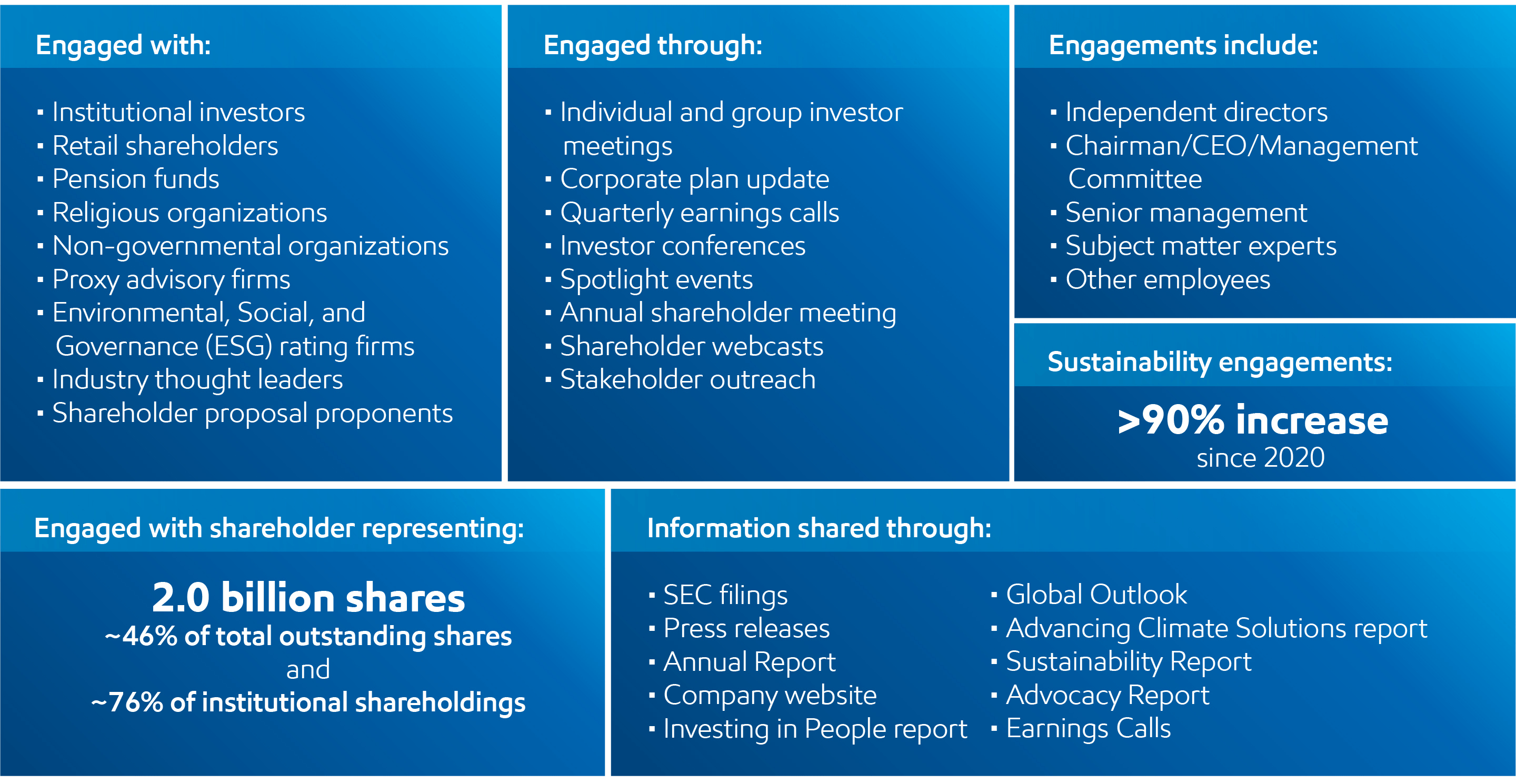
In addition, the Nominating and Governance Committee has procedures for shareholders and others to reach out to Board members. Individuals can email our non-employee directors through our website. All communications are recorded by an assistant secretary or designated staff member and forwarded to the appropriate director or directors, or otherwise handled as the Committee directs.
Our engagements can often address areas of interest without the need for formal shareholder proposals. Each year, shareholders or their proxies submit proposals as allowed by SEC Rule 14a-8. Company management and the Board consider each proposal, and the company seeks a dialogue with the proposal sponsor.
At the 2025 annual meeting, shareholders owning more than 3.6 billion outstanding shares, or approximately 84%, were represented. In 2025, the shareholder vote aligned with the Board’s recommendations on all items. More information on the voting outcomes can be found in the 2025 proxy voting results.
Corporate governance
2025 Proxy Statement
2025 Proxy Results
Engaging with governments
Policy decisions made at all levels of government can affect our operations, now and in the future. We actively participate in discussions around the world to support policies that promote economic growth, stable investment for long-term business viability, energy security, and the development and acceleration of lower-emission solutions.
We focus on rational and constructive policy that reflects the “and” equation – growing the supply of affordable and reliable energy products that improve living standards around the world and supporting scalable development and deployment of lower- and zero-greenhouse gas emission technologies.
Such policies can further encourage investments in lower-emission technologies to advance an energy transition at the lowest cost to society.
ExxonMobil’s positions on climate, including its 2030 greenhouse gas emission-reduction plans,5 are available on our website and in our Advancing Climate Solutions report, along with our annual proxy statement, press releases, and the Exxchange, our online advocacy hub. Our lobbying and political contributions are aligned with these positions.
Positions and principles
Advocacy Report
Advancing Climate Solutions
2026 Proxy Statement
Press releases
Exxchange
Political contributions
Transparency in payments to governments
We believe that disclosing relevant payments to governments is an important tool to reduce corruption, improve government accountability, and promote greater economic stability worldwide. We consider the most successful transparency initiatives to be those that:
- Apply to all foreign, domestic, and state-owned companies.
- Protect proprietary information to promote commercial competitiveness.
- Comply with international trade conventions and treaties.
- Do not violate host government laws or contractual obligations.
ExxonMobil is a founding member of Extractive Industries Transparency Initiative (EITI), a global organization that promotes the accountable management of oil, natural gas, and mineral resources. We share EITI’s view that fiscal transparency helps citizens hold their government leaders accountable and combat corruption. This idea squarely aligns with our values, and it’s important for good resource governance. Every year, an ExxonMobil representative serves on the EITI board as either a primary or alternate member, and we actively participate at the EITI secretariat and country levels. Companies and governments participating in EITI report payments and revenues, which enables EITI to reconcile any differences between the totals and publish validated total government revenues. ExxonMobil reports project-level data regarding our payments to governments or their agents where applicable in EITI implementing countries, specifically where we conduct upstream operations.


Publications
Explore more
Content index
Data
•
6 min read
• May 21, 2026
Enhancing process safety
Report
•
3 min read
• May 5, 2026
Leading in personnel safety
Report
•
3 min read
• May 5, 2026About our Advancing Climate Solutions and Sustainability Reports and Cautionary Statement
Report
•
4 min read
• May 5, 2026
Improving air quality
Report
•
2 min read
• May 5, 2026
Metrics and data
Report
•
8 min read
• May 5, 2026- https://www.ipieca.org
- Sustainability Reporting Guidance for the Oil and Gas Industry (5th edition, 2025) developed by Ipieca, the American Petroleum Institute, and the International Association of Oil & Gas Producers.
- Lower emissions investments include cash capex attributable to carbon capture and storage, hydrogen, lithium, biofuels, ProxximaTM systems, carbon materials, and activities to lower ExxonMobil’s emissions and/or third party emissions. Source: 2025 Corporate Plan Update.
- Middle East and related disruptions to throughput may affect progress of our planned methane-intensity reductions in 2026; however, ExxonMobil’s 2030 methane-intensity reduction plan remains unchanged. Intensity is calculated as emissions per metric ton of throughput/production. ExxonMobil 2030 GHG emission-reduction plans are intensity-based and for Scope 1 and 2 greenhouse gas emissions from operated assets compared to 2016 levels. For more information, see our Advancing Climate Solutions report.
- ExxonMobil 2030 GHG emission-reduction plans are intensity-based and for Scope 1 and 2 greenhouse gas emissions from operated assets compared to 2016 levels. For more information, see our Advancing Climate Solutions report.
FORWARD-LOOKING STATEMENT WARNING
CAUTIONARY STATEMENT RELEVANT TO FORWARD LOOKING INFORMATION FOR THE PURPOSE OF THE “SAFE HARBOR” PROVISIONS OF THE PRIVATE SECURITIES LITIGATION REFORM ACT OF 1995 AND OTHER IMPORTANT LEGAL DISCLAIMERS
Images or statements of future ambitions, aims, aspirations, plans, goals, events, projects, projections, opportunities, expectations, performance, potential addressable markets or conditions in the publications, including plans to reduce, abate, avoid or enable avoidance of emissions or reduce emissions intensity, sensitivity analyses, estimates, the development of future technologies, business plans, and sustainability efforts are dependent on future market factors, such as customer demand, continued technological progress, stable policy support and timely rule-making or continuation of government incentives and funding, and represent forward-looking statements. Similarly, emission-reduction roadmaps to drive toward net zero and similar roadmaps for emerging technologies and markets, and water management roadmaps to reduce freshwater intake and/or manage disposal, are forward-looking statements. These statements are not guarantees of future corporate, market or industry performance or outcomes for ExxonMobil or society and are subject to numerous risks and uncertainties, many of which are beyond our control or are even unknown.
Actual future results, including the achievement of ambitions to reach Scope 1 and 2 net zero from operated assets by 2050, to reach Scope 1 and 2 net zero in integrated Upstream Permian Basin unconventional operated assets by 2035, to eliminate routine flaring in-line with World Bank Zero Routine Flaring, to reach near zero methane emissions from operated assets and other methane initiatives to meet ExxonMobil’s greenhouse gas emission reduction plans and goals, divestment and start-up plans, and associated project plans as well as technology advances, including in the timing and outcome of projects to capture, transport and store CO2, produce hydrogen and ammonia, produce lower-emission fuels, produce ProxximaTM systems, produce carbon materials, produce lithium, and use plastic waste as feedstock for advanced recycling; future debt levels and credit ratings; business and project plans, timing, costs, capacities and profitability; resource recoveries and production rates; planned Denbury and Pioneer integrated benefits; detection, measurement and quantification of emissions including obtaining or reporting of that data or updates to previous estimates and progress in sustainability focus areas could vary depending on a number of factors. These include, global or regional changes or imbalances in the supply and demand for oil, gas, petrochemicals, and feedstocks and other market factors; economic conditions and seasonal fluctuations that impact prices, differentials, and volume/mix for our products; new market products and services; future cash flows; our ability to execute operational objectives on a timely and successful basis; the ability to realize efficiencies within and across our business lines; developments or changes in local, national, or international treaties, laws, regulations, taxes, trade sanctions, trade tariffs, or policies affecting our business, such as government policies supporting lower-carbon and new market investment opportunities, or policies limiting the attractiveness of investments such the punitive European taxes on the oil and gas sector and unequal support for different technological methods of emissions reduction or evolving, ambiguous, and unharmonized voluntary and mandatory standards and extraterritorial laws and regulations imposed by various jurisdictions related to sustainability and greenhouse gas reporting and evolving measurement standards for these topics; timely granting of governmental permits, licenses, and certifications; uncertain impacts of deregulation on the legal and regulatory environment; trade patterns and the development and enforcement of local, national and regional mandates; unforeseen technical or operational difficulties; the outcome of research efforts and future technology developments, including the ability to scale projects and technologies such as electrification of operations, advanced recycling, carbon capture and storage, hydrogen and ammonia production, ProxximaTM systems, carbon materials or direct lithium extraction on a commercially competitive basis; the development and competitiveness of alternative energy and emission reduction technologies; unforeseen technical or operating difficulties, including the need for unplanned maintenance; availability of feedstocks for lower-emission fuels, hydrogen, or advanced recycling; changes in the relative energy mix across activities and geographies; the actions of co-venturers or competitors; changes in regional and global economic growth rates and consumer preferences including willingness and ability to pay for reduced emissions products; actions taken by governments and consumers resulting from a pandemic; changes in population growth, economic development or migration patterns; timely completion of construction projects; war, civil unrest, attacks against the Company or industry, and other political or security disturbances, including disruption of land or sea transportation routes; decoupling of economies, realignment of global trade and supply chain networks, and disruptions in military alliances; and other factors discussed here and in Item 1A. Risk Factors of our Annual Report on Form 10-K and under the heading “Factors affecting future results” available under the “Earnings” tab through the “Investors” page of our website at www.exxonmobil.com. The Advancing Climate Solutions Report includes 2025 greenhouse gas emissions performance data as of March 13, 2026, and Scope 3 Category 11 estimates for full year 2025 as of March 13, 2026. The greenhouse gas intensity and greenhouse gas emission estimates include Scope 2 market-based emissions. The Sustainability Report, the Advancing Climate Solutions Report, and combined Executive Summary were issued on May 5, 2026. The content and data referenced in these publications focus primarily on our operations from Jan. 1, 2025 – Dec. 31, 2025, unless otherwise indicated. Tables on our “Metrics and data” page were updated to reflect full year 2025 data. Information regarding some known events or activities in 2026 and historical initiatives from prior years are also included. No party should place undue reliance on these forward-looking statements, which speak only as of the dates of these publications. All forward-looking statements are based on management’s knowledge and reasonable expectations at the time of publication. ExxonMobil assumes no duty to update these statements or materials as of any future date, and neither future distribution of this material nor the continued availability of this material in archive form on our website should be deemed to constitute an update or re-affirmation of these figures or statements as of any future date. Any future update will be provided only through a public disclosure indicating that fact.
See “ABOUT THE ADVANCING CLIMATE SOLUTIONS AND SUSTAINABILITY REPORTS” at the end of this document for additional information on these reports and the use of non-GAAP and other financial measures.
ABOUT THE ADVANCING CLIMATE SOLUTIONS AND SUSTAINABILITY REPORTS
The Advancing Climate Solutions Report contains terms used by the third-party disclosure frameworks. In doing so, ExxonMobil is not obligating itself to use any terms in the way defined or interpreted by any third-party, nor is it obligating itself to comply with any specific recommendation of such parties or to provide any specific disclosure. For example, with respect to the term “material,” individual companies are best suited to determine what information is material, under the long-standing U.S. Supreme Court definition, and whether to include this information in U.S. Securities and Exchange Act filings. The Sustainability Report and Advancing Climate Solutions Report are each a voluntary disclosure and are not designed to fulfill any U.S., foreign, or third-party required reporting framework.
Forward-looking and other statements regarding environmental and other sustainability efforts and aspirations are not intended to communicate any material investment information under the laws of the United States or elsewhere or represent that these are required disclosures in any other context or jurisdiction. These publications are not intended to imply that ExxonMobil has access to any significant non-public insights on future events that the reader could not independently research. In addition, historical, current, and forward-looking environmental, climate-related, and other sustainability-related statements may be based on standards for measuring progress that are still developing, internal controls and processes that continue to evolve, and assumptions that are subject to change in the future, including future laws and rulemaking. Forward-looking and other statements regarding environmental and other sustainability efforts and aspirations are for informational purposes only and are not intended as an advertisement for ExxonMobil’s equity, debt, businesses, products, or services and the reader is specifically notified that any investor-requested disclosure or future required disclosure is not and should not be construed as an inducement for the reader to purchase any product, services, or security. The statements and analysis in these publications represent a good faith effort by the Company to address these investor requests despite significant unknown variables and at times inconsistent market data, government policy signals, and calculation methodologies and reporting standards.
Actions needed to advance ExxonMobil’s 2030 greenhouse gas emission-reductions plans are incorporated into its medium-term business plans, which are updated annually. The reference case for planning beyond 2030 is based on the Company’s Global Outlook research and publication. The Global Outlook is reflective of the existing global policy environment and an assumption of increasing policy stringency and technology improvement to 2050. However, the Global Outlook does not attempt to project the degree of required future policy and technology advancement and deployment for the world, or ExxonMobil, to meet net zero by 2050. As future policies and technology advancements emerge, they will be incorporated into the GIobal Outlook, and the Company’s business plans will be updated as appropriate. References to projects or opportunities may not reflect investment decisions made by the corporation or its affiliates. Individual projects or opportunities may advance based on a number of factors, including availability of stable and supportive policy, permitting, technological advancement for cost-effective abatement, insights from the company planning process, and alignment with our partners and other stakeholders. Capital investment guidance in lower-emission and other new investments is based on our corporate plan; however, actual investment levels will be subject to the availability and attractiveness of investment opportunities, market conditions, stable public policy support, other factors, and focused on returns.
Energy demand modeling is forward-looking by nature aims to replicate integrated dynamics of the global energy system but necessarily involves simplifications to simulate its complexity. The reference to any modeled scenario or any pathway for an energy transition or expansion, including any potential net-zero scenario, does not imply ExxonMobil views any particular scenario as likely to occur. In addition, energy demand scenarios require assumptions on a variety of parameters. As such, the outcome of any given scenario using an energy demand model comes with a high degree of uncertainty. Third-party scenarios discussed in these reports reflect the modeling assumptions and outputs of their respective authors, not ExxonMobil, and their use or inclusion herein is not an endorsement by ExxonMobil of their underlying assumptions, likelihood, or probability. Investment decisions are made on the basis of ExxonMobil’s separate planning process but may be secondarily tested for robustness or resiliency against different assumptions, including against various scenarios. These reports contain information from third parties. ExxonMobil makes no representation or warranty as to the third-party information. Where necessary, ExxonMobil received permission to cite third-party sources, but the information and data remain under the control and direction of the third parties. ExxonMobil has also provided links in this report to third-party websites for ease of reference. ExxonMobil’s use of the third-party content is not an endorsement or adoption of such information.
ExxonMobil reported emissions, including reductions and avoidance performance data, are based on a combination of measured and estimated data. We assess our performance to support continuous improvement throughout the organization using our Environmental Performance Indicator (EPI) manual. The reporting guidelines and indicators in the Ipieca, the American Petroleum Institute (API), the International Association of Oil and Gas Producers Sustainability Reporting Guidance for the Oil and Gas Industry (5th edition, 2025) and key chapters of the GHG Protocol inform the EPI and the selection of the data reported. Emissions reported are estimates only, and performance data depends on variations in processes and operations, the availability of sufficient data, the quality of those data and methodology used for measurement and estimation. Emissions data is subject to change as methods, data quality, and technology improvements occur, and changes to performance data may be updated. Emissions, reductions, abatements and enabled avoidance estimates for non-ExxonMobil operated facilities are included in the equity data and similarly may be updated as changes in the performance data are reported. ExxonMobil’s plans to reduce emissions are good-faith efforts based on current relevant data and methodology, which could be changed or refined. ExxonMobil works to continuously improve its approach to estimate, detect, measure, and address emissions. ExxonMobil actively engages with industry, including API and Ipieca, to improve emission factors and methodologies, including measurements and estimates.
Any reference to ExxonMobil’s support of, work with, or collaboration with a third-party organization within these publications do not constitute or imply an endorsement by ExxonMobil of any or all of the positions or activities of such organization. ExxonMobil participates, along with other companies, institutes, universities and other organizations, in various initiatives, campaigns, projects, groups, trade organizations, and other collaborations among industry and through organizations like the United Nations that express various ambitions, aspirations and goals related to climate change, emissions, sustainability, and an energy transition or expansion. ExxonMobil’s participation or membership in such collaborations is not a promise or guarantee that ExxonMobil’s individual ambitions, future performance or policies will align with the collective ambitions of the organizations or the individual ambitions of other participants, all of which are subject to a variety of uncertainties and other factors, many of which may be beyond ExxonMobil’s control, including government regulation, availability and cost-effectiveness of technologies, and market forces, geopolitical, realignment, conflicts and other risks and uncertainties. Such third parties’ statements of collaborative or individual ambitions and goals frequently diverge from ExxonMobil’s own ambitions, plans, goals, commitments and investments. ExxonMobil will continue to make independent decisions regarding the operation of its business, including its climate-related and sustainability-related ambitions, plans, goals, commitments, and investments. ExxonMobil’s future ambitions, plans, goals commitments, and investments reflect ExxonMobil’s current plans, and ExxonMobil may unilaterally change them for various reasons, including adoption of new reporting standards or practices, market conditions; changes in its portfolio; and financial, operational, regulatory, reputational, legal and other factors.
References to “resources,” “resource base,” and similar terms refer to the total remaining estimated quantities of oil and natural gas that are expected to be ultimately recoverable. The resource base includes quantities of oil and natural gas classified as proved reserves, as well as quantities that are not yet classified as proved reserves, but that are expected to be ultimately recoverable. The term “resource base” is not intended to correspond to SEC definitions such as “probable” or “possible” reserves. For additional information, see the “Frequently Used Terms” on the Investors page of the Company’s website at www.exxonmobil.com under the header “Modeling Toolkit.” References to “oil” and “gas” include crude, natural gas liquids, bitumen, synthetic oil, and natural gas. The term “project” as used in these publications can refer to a variety of different activities and does not necessarily have the same meaning as in any government payment transparency reports.
Exxon Mobil Corporation has numerous affiliates, many with names that include ExxonMobil, Exxon, Mobil, Esso, and XTO. For convenience and simplicity, those terms and terms such as “Corporation,” “company,” “our,” “we,” and “its” are sometimes used as abbreviated references to one or more specific affiliates or affiliate groups. Abbreviated references describing global or regional operational organizations, and global or regional business lines are also sometimes used for convenience and simplicity. Nothing contained herein is intended to override the corporate separateness of affiliated companies. Exxon Mobil Corporation’s goals do not guarantee any action or future performance by its affiliates or Exxon Mobil Corporation’s responsibility for those affiliates’ actions and future performance, each affiliate of which manages its own affairs. For convenience and simplicity, words like venture, joint venture, partnership, co-venturer and partner are used to indicate business relationships involving common activities and interests, and those words may not indicate precise legal relationships. These publications cover Exxon Mobil Corporation’s owned and operated businesses and do not address the performance or operations of our suppliers, contractors or partners unless otherwise noted. In the case of certain joint ventures for which ExxonMobil is the operator, we often exercise influence but not control. Thus, the governance, processes, management and strategy of these joint ventures may differ from those in these reports. ExxonMobil completed the acquisitions of Denbury Inc. and Pioneer Natural Resources Company in 2023 and 2024, respectively. These reports and the data therein do not speak of these companies’ pre-acquisition governance, risk management, strategy approaches, or emissions or sustainability performance unless specifically referenced.
These reports or any material therein are not to be used or reproduced without the permission of Exxon Mobil Corporation. All rights reserved
SUPPLEMENTAL INFORMATION FOR NON-GAAP AND OTHER MEASURES
The Positioned for Growth in a Lower-Emission Future section of the Advancing Climate Solutions Report mentions our assessment of the strength our business and investment portfolio against a range of future outcomes, including third-party scenarios. The Company believes this can be helpful in assessing the resiliency of the business to generate cash from different potential future markets. The performance data presented in the Advancing Climate Solutions Report and Sustainability Report, including on emissions, is not financial data and is not GAAP data.